publish date 2026-07-30
Welcome back! This is Canaan's weekly newsletter on Bitcoin mining, energy, and compute infrastructure.
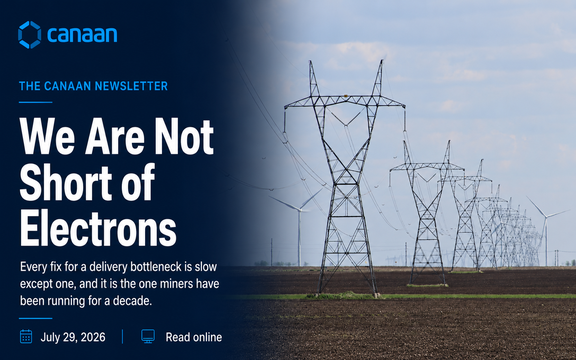
The answer to what’s holding back the AI compute buildout keeps changing. First it was chips. Then transformers. Then generation. Now, many argue the biggest bottleneck is delivery.
The arithmetic is not close. Grid Strategies and Americans for a Clean Energy Grid estimate the DOE's National Transmission Planning Study build rate to be roughly 5,000 miles of new high-capacity regional transmission per year. But they found that only 322 miles of new 345 kV-and-above line were completed in 2024, the third-lowest annual total in fifteen years. An addendum drawing on revised FERC data raises the same year to 888 miles. Either way, the country delivered somewhere between 6% and 18% of the implied pace, in a year when demand growth has been huge.
The development pipeline is certainly not missing. Berkeley Lab's latest Queued Up count found 2,061 GW of generation and storage actively seeking interconnection in the US at the end of 2025, including 549 GW that already holds a draft or executed interconnection agreement without having reached commercial operation.

So the constraint sits in the copper more than in the electrons. The more useful question is what to do about it. Three physical strategies are worth focusing on here, and they run on very different clocks.
Build new lines. Ten to fifteen years, contested siting, cost allocation fights that cross state boundaries. Necessary, but too slow for projects that need power in the next few years.
Get more out of the wires already standing. This is the underrated one. Reconductoring with advanced composite-core conductors can roughly double transfer capacity in suitable corridors within the existing right-of-way, typically at less than half the cost of a new line for a similar capacity increase, and in 18 to 36 months, according to work by UC Berkeley and GridLab published in PNAS. But there is a throughput problem here: only about 1% of the U.S. transmission network is reconductored or rebuilt in a given year. Even the fast fix is running at a trickle.
Stop moving the electrons and move the load instead. This is the one that can sometimes happen on a quarters-not-years timeline.
Curtailment is not one thing here. In some cases, it results from local transmission congestion, energy that could have been delivered if sufficient transmission capacity existed, while some of it reflects a broader imbalance between renewable production and demand in that hour. Transmission primarily addresses the first. Energy storage and flexible demand can address both. What the two categories share is that they resolve differently in the presence of a buyer standing at the generator.
That is the model bitcoin mining has run for a decade, and it explains why "speed to power" has displaced "cheap power" as the phrase that moves valuations. And the pattern extends past electricity. Heat is even more local than power. Pipe costs and thermal losses make transporting heat over long distances expensive, generally making it more economical to bring the compute to the heat customer than to move the heat to the compute.
Canaan's hydro-cooled Avalon units supplying a Nordic district heating network at roughly 80 degrees Celsius, and the 3 MW greenhouse proof of concept in Manitoba, demonstrate that principle taken to its limit.
In the News
Network at a Glance

Project Spotlight
The A11 series arrived in August 2020, less than a year after the A10 flagship. The AvalonMiner 1166 Pro delivered 81 TH/s at 3,400W, about 42 J/TH, across three separately serviceable hashboards.
Set against the 1066 and its 50 TH/s at roughly 65 J/TH, that is a 62% increase in output and about a 35% reduction in energy per terahash: one of the largest single-generation efficiency gains in Avalon's history. It may not have put Canaan at the front of the field, but a machine that closes that much ground in one cycle tells you the design team had found something.

Six years later, 1166 Pros remain in circulation, and a secondary repair ecosystem still supports the model. The machine is not economic at ordinary power prices today, but that does say something about the service life industrial hardware can reach when parts and repair knowledge stay available.
Follow and Contact Us
Disclaimer: This newsletter shares industry commentary and third-party news for informational purposes only. The views and opinions expressed by third-party sources are those of their respective authors and do not necessarily reflect the views of Canaan Inc. For official news, please refer to Canaan’s press releases and SEC filings at https://investor.canaan-creative.com/.
The answer to what’s holding back the AI compute buildout keeps changing. First it was chips. Then transformers. Then generation. Now, many argue the biggest bottleneck is delivery.
The arithmetic is not close. Grid Strategies and Americans for a Clean Energy Grid estimate the DOE's National Transmission Planning Study build rate to be roughly 5,000 miles of new high-capacity regional transmission per year. But they found that only 322 miles of new 345 kV-and-above line were completed in 2024, the third-lowest annual total in fifteen years. An addendum drawing on revised FERC data raises the same year to 888 miles. Either way, the country delivered somewhere between 6% and 18% of the implied pace, in a year when demand growth has been huge.
The development pipeline is certainly not missing. Berkeley Lab's latest Queued Up count found 2,061 GW of generation and storage actively seeking interconnection in the US at the end of 2025, including 549 GW that already holds a draft or executed interconnection agreement without having reached commercial operation.
So the constraint sits in the copper more than in the electrons. The more useful question is what to do about it. Three physical strategies are worth focusing on here, and they run on very different clocks.
Build new lines. Ten to fifteen years, contested siting, cost allocation fights that cross state boundaries. Necessary, but too slow for projects that need power in the next few years.
Get more out of the wires already standing. This is the underrated one. Reconductoring with advanced composite-core conductors can roughly double transfer capacity in suitable corridors within the existing right-of-way, typically at less than half the cost of a new line for a similar capacity increase, and in 18 to 36 months, according to work by UC Berkeley and GridLab published in PNAS. But there is a throughput problem here: only about 1% of the U.S. transmission network is reconductored or rebuilt in a given year. Even the fast fix is running at a trickle.
Stop moving the electrons and move the load instead. This is the one that can sometimes happen on a quarters-not-years timeline.
Curtailment is not one thing here. In some cases, it results from local transmission congestion, energy that could have been delivered if sufficient transmission capacity existed, while some of it reflects a broader imbalance between renewable production and demand in that hour. Transmission primarily addresses the first. Energy storage and flexible demand can address both. What the two categories share is that they resolve differently in the presence of a buyer standing at the generator.
That is the model bitcoin mining has run for a decade, and it explains why "speed to power" has displaced "cheap power" as the phrase that moves valuations. And the pattern extends past electricity. Heat is even more local than power. Pipe costs and thermal losses make transporting heat over long distances expensive, generally making it more economical to bring the compute to the heat customer than to move the heat to the compute.
Canaan's hydro-cooled Avalon units supplying a Nordic district heating network at roughly 80 degrees Celsius, and the 3 MW greenhouse proof of concept in Manitoba, demonstrate that principle taken to its limit.
In the News
- Galaxy Locks In 9.875% Rate on $3.5B AI Data Center Bond Sale
- Poolin Files Chapter 11, Lines Up $52M Sale of Texas Bitcoin Mining Assets
- Bitcoin Miners Defy Nasdaq Rout as AI Infrastructure Deals Fuel Gains
- NAVER, NVIDIA and Brookfield to Expand South Korea's AI Infrastructure to 200 MW by 2028
- Digital Realty Raises 2026 Outlook After Record Second-Quarter Core FFO
- Verizon Signs $1 Billion Dark-Fiber Deal for Google Data Centers
- Morgan Stanley Sees 141% Upside for Hut 8 With $263 Price Target
Network at a Glance
- BTC price (USD): ~$64,108
- Network hashrate: 868 EH/s
- Difficulty: 126.23T
- Hashprice: ~$32.15 / PH / day
Project Spotlight
The A11 series arrived in August 2020, less than a year after the A10 flagship. The AvalonMiner 1166 Pro delivered 81 TH/s at 3,400W, about 42 J/TH, across three separately serviceable hashboards.
Set against the 1066 and its 50 TH/s at roughly 65 J/TH, that is a 62% increase in output and about a 35% reduction in energy per terahash: one of the largest single-generation efficiency gains in Avalon's history. It may not have put Canaan at the front of the field, but a machine that closes that much ground in one cycle tells you the design team had found something.
Six years later, 1166 Pros remain in circulation, and a secondary repair ecosystem still supports the model. The machine is not economic at ordinary power prices today, but that does say something about the service life industrial hardware can reach when parts and repair knowledge stay available.
Follow and Contact Us
- X: @canaanio
- Youtube: Canaanmining
- LinkedIn: Canaan Inc.
- Website: canaan.io
- Support: Customer Care
Disclaimer: This newsletter shares industry commentary and third-party news for informational purposes only. The views and opinions expressed by third-party sources are those of their respective authors and do not necessarily reflect the views of Canaan Inc. For official news, please refer to Canaan’s press releases and SEC filings at https://investor.canaan-creative.com/.