publish date 2026-06-10
Welcome back! This is Canaan's weekly update on bitcoin mining, energy, and compute infrastructure.
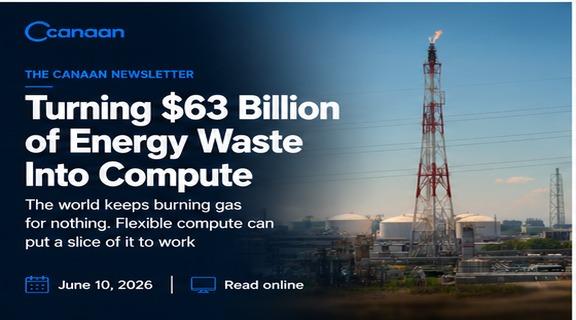
In 2024, the world flared 151 billion cubic meters of gas, according to the World Bank's Global Gas Flaring Tracker. That gas was set on fire for no return at all, simply because it surfaced as a byproduct of oil in places with no pipeline, no processing plant, and no buyers within reach. That volume of gas (estimated to be worth $63B) corresponds to the yearly consumption of Germany and Italy combined, or that of the entire African continent. Nine countries account for three-quarters of the total while producing less than half the world's oil. And flaring intensity (the gas wasted per barrel) has barely moved in the past decade.

A well-run flare combusts about 92% of its methane, with the rest slipping into the atmosphere unburned. To make things worse, some companies and countries just vent raw gas without even bothering to burn it. Methane is roughly 80 times more potent than CO₂, and the IEA claims it’s single-handedly responsible for about a third of the warming the world has seen since the Industrial Revolution.
The reason all this gas still goes up in smoke every year is that those molecules have no local buyers. Pipelines take years and hundreds of millions of dollars to permit and lay. Thus, transporting the gas will never justify the revenue.
In other words, this is a routing problem. And the cleanest answer to a routing problem is not to move the gas—it’s to move the demand.
Whether it is hashing Bitcoin or running an AI inference cluster, a modular data center is the type of load you can truck to a wellhead, fire on a gas generator, and switch on in weeks. Regardless of the location, it can turn stranded gas into electricity and electricity into a product with a global market without the need to build a pipeline. Because the gas is being monetized in the process, combustion efficiency climbs toward 99%, which in turn can cut CO₂-equivalent emissions.
https://x.com/TFTC21/status/2024213077315473816
In addition to the potentially compelling cost of power and the environmental impact, there’s another benefit in this approach. Many think AI and Bitcoin are a problem for the grid (despite some of the evidence pointing to the contrary). But when these loads absorb energy that the grid was never going to receive, it’s just not possible for this growth in demand to constrain substations. Paired with a grid interconnection, the most flexible sites can even curtail during peak stress or push power back when the system needs it.
In a pilot announced with Aurora AZ Energy, Canaan announced the installation of more than $2 million of Avalon A15 Pro miners and modular data centers directly at wellheads in Alberta, Canada—converting flared and stranded gas into roughly 2.5 MW of compute capacity at the source.
https://x.com/matthew_sigel/status/1977728627627249904
The pilot is a small footprint against a 151-bcm problem, but the logic underneath it holds. When compute can go to the energy site instead of dragging the energy to the compute, operators can monetize the energy that was being destroyed, they can keep more methane out of the air, and reduce the burden on the grid. The energy problem is really a logistics one, and this industry can turn it into an opportunity.
In the News
-
Applied Digital signs $5.2 billion AI data center lease for new southern campus
-
IREN signs transmission deal for planned 800 MW data center campus in South Australia
-
Bitdeer discloses leadership shake-up amid deeper push into AI infrastructure
-
Cipher Digital seeks $810M debt raise to fund Stingray data center
-
Applied Digital secures $350M revolver as CoreWeave lease move takes shape
-
OpenAI files confidentially for IPO, following Anthropic's move toward public markets
-
Bitdeer breaks ground on $155 million Alberta bitcoin mining site with 101 MW gas plant
-
DMG signs 50 MW AI colocation LOI for Christina Lake bitcoin mining site
Network at a Glance
-
BTC price (USD): ~$62,177
-
Network hashrate: ~862 EH/s
-
Difficulty: 138.96 T
-
Hashprice: ~$28.35 / PH / day

Project Spotlight
Last week we featured the A3218, the chip at the heart of the Avalon6. This week, the lineage crosses the node that it would come to be defined by.
The Avalon721, built on the 16nm A3212, was Canaan's first 16nm miner—a full process generation beyond the 28nm parts that powered the Avalon4 and Avalon5. It delivered roughly 6 TH/s at around 900W, and it shipped under the ROQ ("Reliable Open Quality") branding. The name was a thesis. While much of the industry was racing on raw hashrate alone, Canaan leaned on uptime, build quality, and the open-hardware ethos that had defined Avalon since the very first units. The design details and documentation were shared openly, a continuation of the DIY culture that grew up around earlier chips like the A3255 and A3233.

The 16nm shrink is what made the 721 matter. Each node step compounds: more hashes per watt, more machines per megawatt, lower cost per terahash. The same efficiency logic that started here is the reason today's fleets can run economically on the thinnest of margins — including on a gas generator at a remote wellhead.
Follow and Contact Us
-
X: @canaanio
-
Youtube: Canaanmining
-
LinkedIn: Canaan Inc.
-
Website: canaan.io
-
Support: Customer Care
Disclaimer: This newsletter shares industry commentary and third-party news for informational purposes only. The views and opinions expressed by third-party sources are those of their respective authors and do not necessarily reflect the views of Canaan Inc. For official news, please refer to Canaan’s press releases and SEC filings at https://investor.canaan-creative.com/.