publish date 2026-06-24
Welcome back! This is Canaan's weekly update on Bitcoin mining, energy, and compute infrastructure.
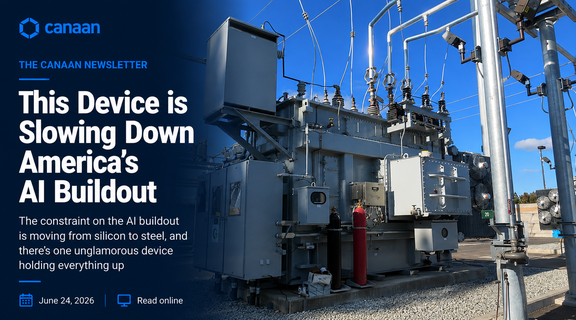
For years, the AI buildout has been a story of GPU allocation, foundry capacity, and who could get Nvidia hardware first. And while securing chips is still not easy, one of the biggest constraints now sits in a fenced-off yard outside a substation.

The power transformer - a device that steps high-voltage transmission power down to something a data center can actually use - has become the binding constraint on U.S. compute growth. Bloomberg reported in April that close to half the data centers planning to come online in the U.S. for 2026 are now expected to slip or be cancelled. This is not because of a lack of capital or land, but because the electrical gear needed to energize them is in critically short supply. While this electrical equipment is only a small fraction of a data center's total cost, it has effectively become the entire source of its schedule risk.
The numbers behind the shortage are stark. Before the pandemic, a high-capacity transformer took roughly two years to deliver; analysts now put lead times for the largest units at as long as four to five years. Wood Mackenzie data shows demand for generator step-up transformers rose 274% between 2019 and 2025, while average prices for large power transformers have climbed roughly 77% since 2019. And the bottleneck is structural, since large transformers need specialized electrical steel, copper, and testing capacity. Data centers, grid replacement, renewable interconnection, and electrification are all bidding for the same factory slots.
https://x.com/oguzerkan/status/2040081164174602323
The consequence is that developers are moving behind the meter: generating power on-site at medium voltage and skipping the massive grid-tie transformer altogether. The policy machinery is converging on the same conclusion. On June 19, FERC ordered all six U.S. grid operators to justify or revise their rules for connecting large loads, acknowledging that interconnection has become a national bottleneck. The market is already heading toward on-site generation, modular pre-fabricated power blocks, and flexible loads that can be sited where power already exists.
If the AI buildout trend continues, the transformer shortage will not disappear anytime soon. Even though the hyperscalers plan to spend $650 billion in 2026, this four-year lead time cannot be pulled forward by force. This environment seems to favor the operators who already know how to put megawatts to work without a new grid connection.
In the News
-
FERC Moves to Fast-Track AI Data Centers as Power Bottleneck Becomes National Priority
-
DOE Announces $17.5 Billion Loan Commitment to Revive American Nuclear Supply Chain
-
Hut 8 Investors Reach $2.35M Settlement Over U.S. Bitcoin Merger Claims
-
ROMA Green Finance to Back BlueFlare's Behind-the-Meter AI Infrastructure
-
Sovright Launches Zcash Mining Pool Testnet with Shielded Payouts
Network at a Glance
-
BTC price (USD): ~$61,007
-
Network hashrate: ~965 EH/s
-
Difficulty: 124.93 T
-
Hashprice: ~$30.93 / PH / day

Project Spotlight
By 2018, the open-hardware, hobbyist era that defined Avalon's early chips was giving way to something more industrial. The A3210 was the silicon that carried Canaan across that line. Built on a 16nm process, it powered the Avalon A8 generation: the AvalonMiner 821 (11.5 TH/s, ~1,200W) early in the year and the AvalonMiner 841 (13.6 TH/s, ~1,290W) that April. At roughly 0.1 J/GH it was a clear efficiency step over the A7-series chips, and Canaan paired it with refinements aimed squarely at farm operators.
The "Reliable Open Quality" branding carried over from the 721/741, now joined by the company's Airforming cooling design for better thermals at density.

The A8 was, in hindsight, a proving generation. It was the workhorse Canaan shipped in volume in the run-up to its 2019 Nasdaq listing, when the question was no longer whether the company could design a competitive chip, but whether it could deliver reliable hardware at an industrial scale.
Follow and Contact Us
-
X: @canaanio
-
Youtube: Canaanmining
-
LinkedIn: Canaan Inc.
-
Website: canaan.io
-
Support: Customer Care
Disclaimer: This newsletter shares industry commentary and third-party news for informational purposes only. The views and opinions expressed by third-party sources are those of their respective authors and do not necessarily reflect the views of Canaan Inc. For official news, please refer to Canaan’s press releases and SEC filings at https://investor.canaan-creative.com/.