


publish date 2026-09-16
Welcome back! This is Canaan's weekly newsletter on Bitcoin mining, energy, and compute infrastructure.
Yesterday, the Senate declined to advance the CLARITY Act, falling well short of the 60 votes it needed and effectively ending market structure work for the year. But if we take a step back from that for a moment, there’s another interesting thing happening in bitcoin right now, and it’s roughly 2,500 miles from the Capitol.
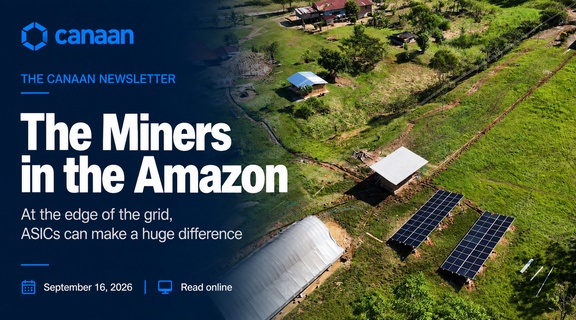
A community in the Colombian Amazon sits at the end of a power line unreliable enough that food spoils and the school goes dark. A solar array now covers the daytime load. And Canaan just donated two Avalon Q units to be deployed in partnership with Cholla, TerraKeepers, and GivePower. The machines will now buy the solar power the community cannot use.
https://x.com/_bradcuddy_/status/2092186122612785543
Small energy systems in unelectrified places rarely fail because of the hardware. An array sized for periods of weak solar production can produce substantially more electricity than the community consumes at midday under favorable conditions. The surplus has no buyer, no wire to run it down, and no cheap way to store the energy. Revenue is capped by a demand curve that collapses after dark while costs keep running.
The June 2026 Tracking SDG 7 report counted 655 million people without electricity and found the pace of electrification has to triple to reach universal access by 2030. International clean energy flows to the least developed countries fell to $3.7 billion in 2024, down 11 percent year over year. Fewer donor dollars against a wider gap means more of these systems have to fund their own maintenance.
Bitcoin mining is still one of the few industrial loads that can show up for a 10 kW site with no road, no interconnection and no offtake agreement. Gridless has been running that trade since 2022. Its Zambian site at the Zengamina hydro plant, built with donations and nearly stranded when operating costs outran revenue, has been selling surplus into mining containers while serving a reported 15,000 people. Virunga in the DRC and Minter Digital in remote Brazil are versions of the same argument.
https://x.com/GridlessCompute/status/1981594786617610283
The hardware here fits perfectly in the site. An industrial ASIC can require three-phase power, a building, and a technician. The Avalon Q runs on 110V to 240V single-phase supply and throttles between roughly 800W and 1,674W, so the machine can be sized to whatever the array has spare in a given hour rather than the other way round. At village scale, dispatchability is not a grid-services product sold into a capacity market. It decides whether a machine can be there at all.
The industry spends most of its argument on whether mining belongs on the grid at gigawatt scale in ERCOT. But an even more durable version of the case may sit at 10 kW, where the alternative to a miner is not a data center and not a battery. It is nothing.
In the News
-
Core Scientific Gets Conditional ERCOT Status for 1 GW at Texas Sites
-
Ionic Gets Provisional ERCOT Status for 466-MW Texas Expansion
-
Fluidstack Gets Site-Work Permit for $4 Billion Texas AI Data Center
-
Keel Taps PowerSecure for Backup Power at Moses Lake Data Center
-
Global AI Wins Colorado Data Center Permit Amid Power, Water Disputes
-
Constellation agrees to purchase Rhode Island power plant from Shell for $715 million
-
Nebius Sued Over Alabama AI Land Deal Allegedly Costing Regions $66 Million
Network at a Glance
-
BTC price (USD): ~$75,722
-
Network hashrate: 978.5 EH/s
-
Difficulty: 127.4T
-
Hashprice: ~$37.6 / PH / day

Project Spotlight
In January 2021 Canaan took the A10 series, the 50 TH/s workhorse built on the 16nm A3205, and put it under dielectric fluid. The result was not really a miner. The A1066I was a tank: up to 90 mining modules in one container, roughly 7,200 TH/s and 306 kW fully stacked, with a claimed 45 percent overclocking factor and none of the dust, noise or thermal throttling that comes with moving air.
https://x.com/canaanio/status/1346042943375777792
Immersion was a choice dictated by the environment, for hot climates, dusty sites, and operators who valued uptime and density above joules per terahash.
The more durable consequence was commercial. Immersion moved the unit of sale from a machine to a site. Nobody buys a single immersion miner for a garage. You buy the tank, the fluid loop, the heat rejection and the controls as one system, which is why immersion adoption tracked the industrialization of mining.
Events and Media
-
Canaan's team is in New York this week for the H.C. Wainwright 28th Annual Global Investment Conference, September 14 to 16 at the Lotte New York Palace.
-
Canaan published its August bitcoin production and mining operations update.
-
CFO James Cheng heads to Washington next week for Freedom Tech DC, the Bitcoin Policy Institute summit at the National Press Club, September 22 to 23.
Follow and Contact Us
-
X: @canaanio
-
Youtube: Canaanmining
-
LinkedIn: Canaan Inc.
-
Website: canaan.io
-
Support: Customer Care
Disclaimer: This newsletter shares industry commentary and third-party news for informational purposes only. The views and opinions expressed by third-party sources are those of their respective authors and do not necessarily reflect the views of Canaan Inc. For official news, please refer to Canaan’s press releases and SEC filings at https://investor.canaan-creative.com/.