


publish date 2026-08-20
Welcome back! This is Canaan's weekly newsletter on Bitcoin mining, energy, and compute infrastructure.
A data center gets financed like a building and filled like a phone. The shell is underwritten over 25 years, while the chips inside it become old in four.
Some argue that GPUs stay useful longer than depreciation schedules assume. If they are right, six years against a 25-year shell still means gutting and refitting the building four times before the mortgage is paid. A longer chip life narrows the gap. It does not close it.
The market is making that argument with real money. On CoreWeave's second-quarter call this month, CEO Mike Intrator said the company had signed an A100 contract running into 2029 at full freight for an architecture NVIDIA introduced in 2020. Pricing on prior-generation SKUs, he said, is at or above where it sat years ago.
CoreWeave ended the quarter with 1.5 GW of active power and, by its August earnings call, had 4.2 GW contracted. Old chips in an energized building beat new chips with nowhere to plug in. And the premium on those older fleets looks fragile: CoreWeave's own testing put NVIDIA's Vera Rubin NVL72 at roughly ten times the tokens per megawatt of GB200 on the same DeepSeek R1 workload. When enough of that capacity lands, nine-year-old Ampere stops looking like a bargain.
https://x.com/StockSavvyShay/status/2088612622929445081
That’s part of why many have been opting for modular construction. The usual pitch for modular is speed. With global capacity expected to keep growing for the rest of the decade, building the traditional way takes 24 to 36 months. Factory-built blocks take 12 to 16 months, and some pre-engineered deployments land under nine.
Then there is the question of whether the demand shows up at all. Wood Mackenzie expects US utilities to commit to only about 28% of the 1,066 GW that developers have requested. If two-thirds of announced load never arrives, the costly mistake is not building slowly. It is building something you cannot undo. A 5 MW block can be moved, restacked, or sold. A purpose-built hall in the wrong county cannot. Colocation developers are learning what miners already knew: until a creditworthy tenant signs, capacity is a bill rather than an asset.
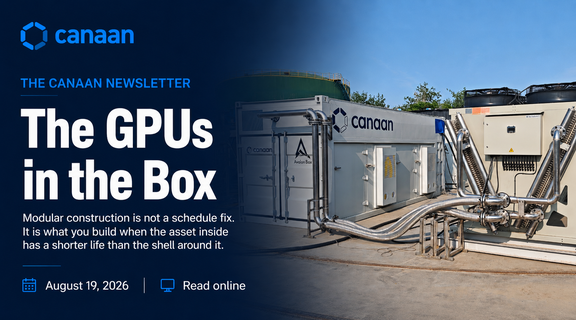
Mining got there first because ASICs left no other option. Nobody was going to pour a permanent facility around a machine with a three-year competitive life, so the industry put the facility in a shipping container instead. That is what the Avalon Box line is: air, hydro, and immersion units in 20- and 40-foot sizes, with power, cooling, and networking already wired in at the factory, stackable when a site needs the density.
With open-weight models now becoming good enough that inference no longer needs a huge campus, the companies least willing to send data outside their own walls will want the machines on site. And since most of them will not design their own systems, they might buy a finished box instead.
https://x.com/Kalshi_Finance/status/2068423835238482333
Ultimately, the question modular really answers is not how fast campuses get built, but whether compute keeps concentrating or starts spreading out. Right now it is doing both, and factory-built blocks are the only way to build without betting on one.
In the News
-
NVIDIA, SB Energy Partner for 8 GW AI Data Center Campus in Ohio
-
WhiteFiber to Buy Two North Carolina AI Data Centers for $60M
-
Core Scientific closes $444 million deal for Polaris, targets 1.5 GW Muskogee campus
-
Soluna Q2 revenue rises 145% as development pipeline reaches 6.3 GW
-
Morgan Stanley raises Riot target to $43 after 191 MW Rockdale lease
-
Abbott's data-center rules appear to leave Meta's $14 billion El Paso project untouched
-
Most Power Sought for US Data Centers Will Never Materialize
Network at a Glance
-
BTC price (USD): ~$68,587
-
Network hashrate: 944 EH/s
-
Difficulty: 127.4T
-
Hashprice: ~$34.23 / PH / day

Project Spotlight
The A1266 was the generation's flagship air-cooled unit: 100 TH/s at 3,500W, 35 J/TH, four fans, and a chassis Canaan positioned as the most compact and quiet in its lineup at the time. Net weight was 12.8 kg in a 301 x 195 x 292 mm case, with noise capped around 75 dB. Announced in 2022, it landed in the middle of the post-halving efficiency race, when the gap between a 35 J/TH machine and the fleet it replaced still decided whether a site cleared its power cost.
https://x.com/canaanio/status/1513350683839197185
The detail worth pulling forward is not the hashrate. The A1266 shipped with an onboard AI chip running an encrypted algorithm to detect tampering and prevent hashrate theft, at a point when hijacked firmware was a live problem for hosted fleets. Canaan was putting
inference silicon inside a mining machine years before edge AI became a category anyone was pitching.
Follow and Contact Us
-
X: @canaanio
-
Youtube: Canaanmining
-
LinkedIn: Canaan Inc.
-
Website: canaan.io
-
Support: Customer Care
Disclaimer: This newsletter shares industry commentary and third-party news for informational purposes only. The views and opinions expressed by third-party sources are those of their respective authors and do not necessarily reflect the views of Canaan Inc. For official news, please refer to Canaan’s press releases and SEC filings at https://investor.canaan-creative.com/.