


publish date 2026-08-26
Welcome back! This is Canaan's weekly newsletter on Bitcoin mining, energy, and compute infrastructure.
Since May, the Department of Energy has used its authority across PJM and Southwest Power Pool. The agency’s orders let grid operators direct any site with at least 50 megawatts of peak load onto its own backup power within fifteen minutes of a signal.
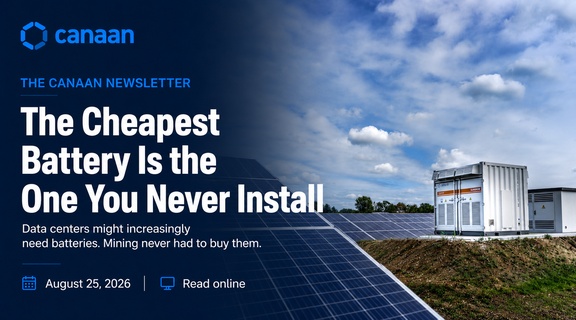
The grid is now reaching past the meter and is treating assets inside the fence as dispatchable resources. That’s why batteries stopped being backup equipment and became an interconnection strategy. Global BESS shipments hit over 400 GWh in 2025 and are projected to reach 600 GWh this year. NEMA has now published dedicated design guidance for integrating energy storage into data centers. Cleanview counts 46 US data centers, roughly 56 GW, planning generation behind the meter. Storage is now specified at masterplanning, not value-engineered later.
https://x.com/RhoMoIola/status/2071979882654134512
What the battery actually buys is narrow and specific: ride-through during transfer, ramp smoothing for training loads that swing hard, frequency response, and the ability to keep serving customers while the main source of power is disconnected. That last one is the whole point. A data center told to reduce load still has to keep running. It has service level agreements. It cannot simply stop.
A miner can. When told to reduce load, it stops. That’s why some say mining is itself a battery. Soluna's John Belizaire has called compute "a better battery." Academic work reaches for "virtual energy storage" and "economic battery."
https://x.com/jbelizaireCEO/status/1958147640224358836
The instinct is right, although the label is not accurate. A battery is two-way. It absorbs, and it injects. Mining can modulate load, but unlike a battery, it cannot return stored electricity to the grid.
From a grid perspective, if the product is absence, mining supplies it natively, and a battery becomes a redundant capex. If markets move toward paying for injection (for the asset that pushes megawatts back during the worst hour), then mining would need a battery like everyone else.
Whether the operators may buy batteries to monetize an interconnection they already hold rather than for uptime could depend on a few things. The queue is one of the biggest ones. Storage cells compete with EV and utility demand for the same supply chain, and the IEA still estimates US and European cell production costs to be as much as 50% above China's. Furthermore, jurisdictions such as Texas HB 3809 are mandating BESS decommissioning, recycling, and financial assurance at the lease level, meaning that every megawatt installed now could have a growing retirement liability in the future.
If mining stores anything, it is not electrons. It is value, and sometimes heat. Canaan's hydro-cooled fleet in the Nordics pushes roughly 80℃ into a district heating network, which is waste-heat recovery with an economic use attached. NG Zhang made an adjacent point: the AI buildout is repeating the early years of mining, including the part where everyone solves the same problem twice before noticing someone already solved it.
In the News
-
DOE Lets PJM Tap AI Data Center Backup Power During Heat Wave
-
Kentucky Clears 482 MW AI Power Deal for TeraWulf's Anthropic Campus
-
NVIDIA, SB Energy Partner for 8 GW AI Data Center Campus in Ohio
-
Tether's $120M Uruguay Bitcoin Mining Bet Ends in Power Dispute
-
Most Power Sought for US Data Centers Will Never Materialize
-
Ionic Revenue Rises 31% as AI Leasing Replaces Bitcoin Mining
-
Bitcoin Hashrate Falls 6.3% as Mining Capital Shifts Toward AI
Network at a Glance
-
BTC price (USD): ~$78,043
-
Network hashrate: 867.5 EH/s
-
Difficulty: 125.8T
-
Hashprice: ~$39.18 / PH / day

Project Spotlight
The topic of this week turns on one assumption: that a fleet can be told what to do and will actually do it. That is a software problem, and Canaan hit it early.
The Avalon Management System was a web-based control layer built when farms outgrew a person's ability to walk the rows. It ran a 20,000-unit Avalon3 deployment, at a time when most operations were still managing miners through spreadsheets and SSH sessions. It included a 3D visualization mode, which reads today like a novelty and at the time was the only practical way to find one dead unit among twenty thousand.
The reason it matters to this week's argument is that flexible load is not a property of a machine. A single miner powering down is a machine failure. Twenty thousand miners powering down on a fifteen-minute signal, in a controlled sequence, and coming back cleanly, is an operating capability. The hardware makes it physically possible. The control layer makes it dispatchable, and dispatchable is the thing grid operators are willing to pay for.
Events and Media
-
Canaan and Leo Wang, vice president of capital markets and business development, will be at Bitcoin Asia in Hong Kong on August 27 and 28. Come visit us at booth #143.
-
Canaan published its monthly production update for July.
-
Gwyn Lauber, vice president of corporate affairs, joined the Becoming Sovereign Podcast to talk home mining.
Follow and Contact Us
-
X: @canaanio
-
Youtube: Canaanmining
-
LinkedIn: Canaan Inc.
-
Website: canaan.io
-
Support: Customer Care
Disclaimer: This newsletter shares industry commentary and third-party news for informational purposes only. The views and opinions expressed by third-party sources are those of their respective authors and do not necessarily reflect the views of Canaan Inc. For official news, please refer to Canaan’s press releases and SEC filings at https://investor.canaan-creative.com/.