


publish date 2026-08-12
Welcome back! This is Canaan’s weekly update on bitcoin mining, energy, and compute infrastructure.
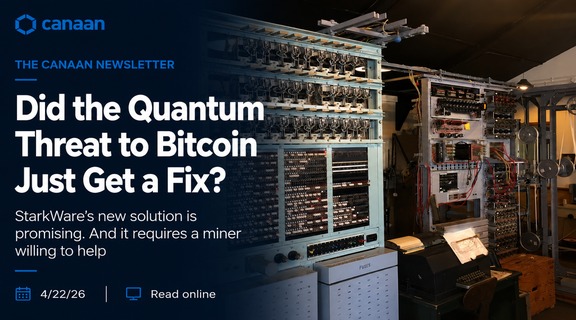
For most of the past decade, the "quantum threat to Bitcoin" conversation has been stuck in a loop. Someone publishes a qubit count milestone, a headline declares Bitcoin at risk, and the response is that the timeline is long, the hardware overhead is staggering, and the protocol can be upgraded before it matters. What changed this month is that the debate moved from "someday" to "here is working code."
A few weeks ago, StarkWare chief product officer Avihu Levy published a paper and open-source implementation for a scheme called Quantum Safe Bitcoin (QSB). The system allows the production of a bitcoin transaction that remains secure against an attacker, without changing Bitcoin’s script rules. The idea is to have the spender use GPUs to solve a "hash-to-signature" puzzle off-chain and attach the solution to the transaction.
This means that Bitcoin could have an escape hatch, and it was built in a few months by one person.
To be clear, mining itself (the SHA-256 proof-of-work that ASICs perform) does not seem to be under threat right now. The part of Bitcoin that’s potentially exposed involves individual wallets. A quantum breakthrough wouldn’t slow mining down. It would mean that anyone holding bitcoin in the wrong kind of address would need a way to move it safely.
The long-term fix is a Bitcoin protocol upgrade along the lines of BIP-360, which would add proper quantum-resistant addresses to the network. Levy himself calls QSB a "last-resort measure" rather than a replacement. The problem is that Bitcoin upgrades take time. The last one in 2021 took four years from proposal to activation. QSB is important because it offers a working backup. In other words, even if the quantum threat suddenly materialized, Bitcoin should still be fine.
But why does this matter to the mining industry? QSB transactions are non-standard, meaning they can be included in the blockchain, but most nodes in the network will not relay them. So to get a QSB transaction confirmed, the sender has to hand it directly to a miner. Today, that can be done by using services like MARA’s Slipstream.
And because QSB runs on GPUs, some miners diversifying into AI/HPC could start offering this as a service. When a customer needs to secure some coins, the miner can run the algorithm on GPUs and include the transaction in the blockchain. Based on Levy’s estimates, the total cost for such service could be as low as a few hundred dollars per transaction.
While it’s still early to make predictions, the role of miners might be greater than what people initially thought. Not only is mining not threatened by quantum computing, but some miners might also pick up a new role in response to it.
In the News
Network at a Glance

Project Spotlight
Released in 2014, the A3233 was Canaan’s first move from 55nm to 40nm - a full node shrink in a single generation. The result was a chip that hit roughly 7 GH/s at around 0.7 W per GH, a step-change in efficiency at a moment when the industry was still figuring out whether Bitcoin ASIC design could sustain the same cadence of improvement that had driven general-purpose semiconductors for decades. The answer, it turned out, was yes. And A3233 was the proof point.

The chip powered two very different machines. On the industrial side, it was the engine inside the Avalon3, Canaan’s first 2U rackmount product and the unit that signaled mining was shifting from hobbyist desktops to data-center racks. On the hobbyist side, it powered the Avalon Nano, a single-chip USB miner small enough to plug into a laptop. The same silicon underneath both: a clear statement that the open-hardware ethos from the A3255 era wasn’t being abandoned just because industrial deployment was taking over.
Events and Media
Follow and Contact Us
Disclaimer: This newsletter shares industry commentary and third-party news for informational purposes only. The views and opinions expressed by third-party sources are those of their respective authors and do not necessarily reflect the views of Canaan Inc. For official news, please refer to Canaan’s press releases and SEC filings at https://investor.canaan-creative.com/.
For most of the past decade, the "quantum threat to Bitcoin" conversation has been stuck in a loop. Someone publishes a qubit count milestone, a headline declares Bitcoin at risk, and the response is that the timeline is long, the hardware overhead is staggering, and the protocol can be upgraded before it matters. What changed this month is that the debate moved from "someday" to "here is working code."
A few weeks ago, StarkWare chief product officer Avihu Levy published a paper and open-source implementation for a scheme called Quantum Safe Bitcoin (QSB). The system allows the production of a bitcoin transaction that remains secure against an attacker, without changing Bitcoin’s script rules. The idea is to have the spender use GPUs to solve a "hash-to-signature" puzzle off-chain and attach the solution to the transaction.
This means that Bitcoin could have an escape hatch, and it was built in a few months by one person.
https://x.com/niftynei/status/2042309636372431083
To be clear, mining itself (the SHA-256 proof-of-work that ASICs perform) does not seem to be under threat right now. The part of Bitcoin that’s potentially exposed involves individual wallets. A quantum breakthrough wouldn’t slow mining down. It would mean that anyone holding bitcoin in the wrong kind of address would need a way to move it safely.
The long-term fix is a Bitcoin protocol upgrade along the lines of BIP-360, which would add proper quantum-resistant addresses to the network. Levy himself calls QSB a "last-resort measure" rather than a replacement. The problem is that Bitcoin upgrades take time. The last one in 2021 took four years from proposal to activation. QSB is important because it offers a working backup. In other words, even if the quantum threat suddenly materialized, Bitcoin should still be fine.
https://x.com/saylor/status/2000975070810824816
But why does this matter to the mining industry? QSB transactions are non-standard, meaning they can be included in the blockchain, but most nodes in the network will not relay them. So to get a QSB transaction confirmed, the sender has to hand it directly to a miner. Today, that can be done by using services like MARA’s Slipstream.
And because QSB runs on GPUs, some miners diversifying into AI/HPC could start offering this as a service. When a customer needs to secure some coins, the miner can run the algorithm on GPUs and include the transaction in the blockchain. Based on Levy’s estimates, the total cost for such service could be as low as a few hundred dollars per transaction.
While it’s still early to make predictions, the role of miners might be greater than what people initially thought. Not only is mining not threatened by quantum computing, but some miners might also pick up a new role in response to it.
In the News
- Public Miners Sell Record Bitcoin as Industry Splits Between Selling and Quality Growth
- Bitcoin Network Difficulty Slides 2.43% and Hashprice Rises 13.65%
- Tether Takes 8.2% Stake in Bitmain-Tied Bitcoin Lender Antalpha
- TeraWulf prices $900 million stock offering for data center expansion
- Riot Data Center Chief Departs Less Than a Year After AI Push
- CleanSpark Shutters 25MW Tennessee Bitcoin Mine
Network at a Glance
- BTC price (USD): $78,648
- Network hashrate: 974 EH/s
- Difficulty: 135.59T
- Hashprice: $36.89 / PH / day
Project Spotlight
Released in 2014, the A3233 was Canaan’s first move from 55nm to 40nm - a full node shrink in a single generation. The result was a chip that hit roughly 7 GH/s at around 0.7 W per GH, a step-change in efficiency at a moment when the industry was still figuring out whether Bitcoin ASIC design could sustain the same cadence of improvement that had driven general-purpose semiconductors for decades. The answer, it turned out, was yes. And A3233 was the proof point.
The chip powered two very different machines. On the industrial side, it was the engine inside the Avalon3, Canaan’s first 2U rackmount product and the unit that signaled mining was shifting from hobbyist desktops to data-center racks. On the hobbyist side, it powered the Avalon Nano, a single-chip USB miner small enough to plug into a laptop. The same silicon underneath both: a clear statement that the open-hardware ethos from the A3255 era wasn’t being abandoned just because industrial deployment was taking over.
Events and Media
- Next week, Leo Wang will speak at the Energy Stage in Las Vegas on April 29 to discuss how home mining is coming back
- Come visit the Canaan team at the Bitcoin 2026 conference in Las Vegas! Look for booth 555
Follow and Contact Us
- X: @canaanio
- Youtube: Canaanmining
- LinkedIn: Canaan Inc.
- Website: canaan.io
- Support: Customer Care
Disclaimer: This newsletter shares industry commentary and third-party news for informational purposes only. The views and opinions expressed by third-party sources are those of their respective authors and do not necessarily reflect the views of Canaan Inc. For official news, please refer to Canaan’s press releases and SEC filings at https://investor.canaan-creative.com/.