publish date 2026-06-03
Welcome back! This is Canaan's weekly update on bitcoin mining, energy, and compute infrastructure.
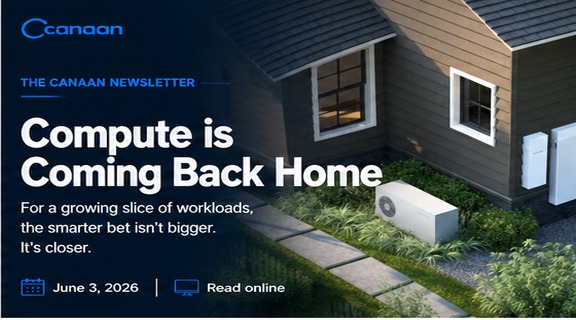
For fifteen years, the computing trend has been characterized by centralization, with big clusters, campuses, and power draws supporting most of the demand. But parallel to the current AI software and infrastructure boom, a countertrend seems to be emerging.
A clear signal came a few months ago, when SPAN announced XFRA, a distributed data center built from compute nodes installed in homes and small commercial buildings, with NVIDIA as a launch partner running liquid-cooled enterprise GPUs. The idea behind it is that, instead of waiting a decade for a gigawatt campus to clear interconnection, you can tap the unused electrical headroom already sitting behind millions of residential meters and aggregate it into capacity.
https://x.com/exec_sum/status/2051697983197225029
While the compute used for training LLMs is unlikely to move outside of big data centers, the workload that answers your queries (inference) can happen locally. And inference is on track to make up more than half of all AI compute by the end of the decade. And because inference is latency-sensitive in a way training is not, improving speed from a campus three states away can be challenging.
That’s why we see a growing portion of this workload slowly migrating toward the user. With inference driving the data center map toward regional and distributed sites, Tier 2 markets, behind-the-meter sites, and even individual households are likely to capture a larger share of capacity in the future.
This countertrend might not even stop there. This week, NVIDIA confirmed RTX Spark, an Arm-based chip pairing Blackwell GPU cores with up to 128GB of unified memory, will be installed in consumer Windows laptops and mini-desktops. The unified memory pool will let a machine run AI models locally, without requiring a trip to the cloud or a subscription. Local computation allows users to process the data where it's created and where it rests, keep it private, and increase speed at the software level.
https://x.com/NVIDIARTXSpark/status/2061305494539469143
While there are some notable differences, Bitcoin mining has been going through similar cycles.
Mining began at home, with CPUs, then GPUs, FPGAs, and then the first consumer ASICs shipped to hobbyists. As difficulty climbed, economics forced ruthless centralization into industrial farms parked on the cheapest megawatts on earth. That was the right move for a decade. But the countertrend is now visible: a renaissance of home and small-scale mining. At Bitcoin 2026 last month, Canaan joined a roundtable pointedly titled "Bitcoin's Return to Its Roots: Why Home Mining Is Making a Comeback." The company’s Avalon Home line exists because the same forces pulling AI inference toward the user are pulling hashrate back too.
For the end user, distributed computing means lower latency, more privacy (data processed locally, not shipped to a hyperscaler), and maybe even discounted power and connectivity (as in SPAN's model).
Another thing that might tie the two trends together is heat. A GPU node in a basement and an ASIC in a living room have the same inconvenient byproduct and the same opportunity. Small pilots are proving that capturing 90% of the electricity used by a computing system can also become usable heat. This heat can also be piped directly into a district hot-water system. A distributed compute node that warms a home becomes a second revenue stream and a reason for the homeowner to host it.
None of this replaces the gigawatt campus: training still wants scale, and there’s a reason why players such as SoftBank are still committing tens of billions to multi-gigawatt sites. But for a growing share of workloads, the smarter bet will be closer, not bigger.
In the News
-
IREN Secures Connection for 800MW AI Data Center in South Australia
-
Bitdeer Starts Construction on $155 Million Integrated Energy and Computing Hub in Alberta
-
HIVE Reports 158% Jump in Annual Revenue to $298 Million as Bitcoin Holdings Fall to 150 BTC
-
Anthropic Files Confidentially for U.S. IPO Amid Race for Public Market Capital
-
PJM's $23B Warning: AI Load Is No Longer Just a Power Demand Story
-
Submer launches Rubix Data Centers, claims platform has 8GW powered land portfolio
Network at a Glance
-
BTC price (USD): ~$66,528
-
Network hashrate: ~948 EH/s
-
Difficulty: 136.96 T
-
Hashprice: ~$30.49 / PH / day

Project Spotlight
By late 2015, Bitcoin mining had gone fully industrial, which makes the chip at the heart of the Avalon6 an instructive artifact. The A3218 was Canaan's mature 28nm ASIC, eighty of them packed into a single unit clocked at 500 MHz to deliver about 3.5 TH/s at roughly 0.29 W/GH, drawing close to 1,000 watts at the wall.

When Avalon designed the A3218, bleeding-edge 14nm Samsung silicon was on the table. The newer node was expensive, slow to yield, and didn't deliver efficiency gains worth the cost and risk at the time. So Avalon shipped a well-understood 28nm part that worked, on time, at scale - and let the process shrink wait until the economics actually justified it.
That choice has aged well as a piece of engineering philosophy. The Avalon6 also kept the line's hobbyist DNA: a Raspberry Pi controller, daisy-chained units, a compact and famously quiet form factor that kept it popular with smaller operators even as warehouse-scale farms took over the network. It was an industrial-era chip that never fully forgot the home.
Ten years on, that instinct—right-sized hardware, quiet enough to live alongside people, efficient enough to matter—is exactly what the Avalon Home line is built around. The A3218 was a bridge between two eras of mining, and we may be walking back across it.
Events and Media
-
The Canaan team hosted a community X Space titled “Crawl, Walk, Run: A Beginner’s Path Into Bitcoin Mining”, picking up this week's thread on home mining and heat reuse. Listen back here.
-
Canaan founder NG Zhang answered The Cryptonomist's questions on Avalon miners, the home-mining revival, and why "continuous computing inevitably generates heat" (and why that points toward home AI, not just home mining).
Follow and Contact Us
-
X: @canaanio
-
Youtube: Canaanmining
-
LinkedIn: Canaan Inc.
-
Website: canaan.io
-
Support: Customer Care
Disclaimer: This newsletter shares industry commentary and third-party news for informational purposes only. The views and opinions expressed by third-party sources are those of their respective authors and do not necessarily reflect the views of Canaan Inc. For official news, please refer to Canaan’s press releases and SEC filings at https://investor.canaan-creative.com/.