


publish date 2026-11-25
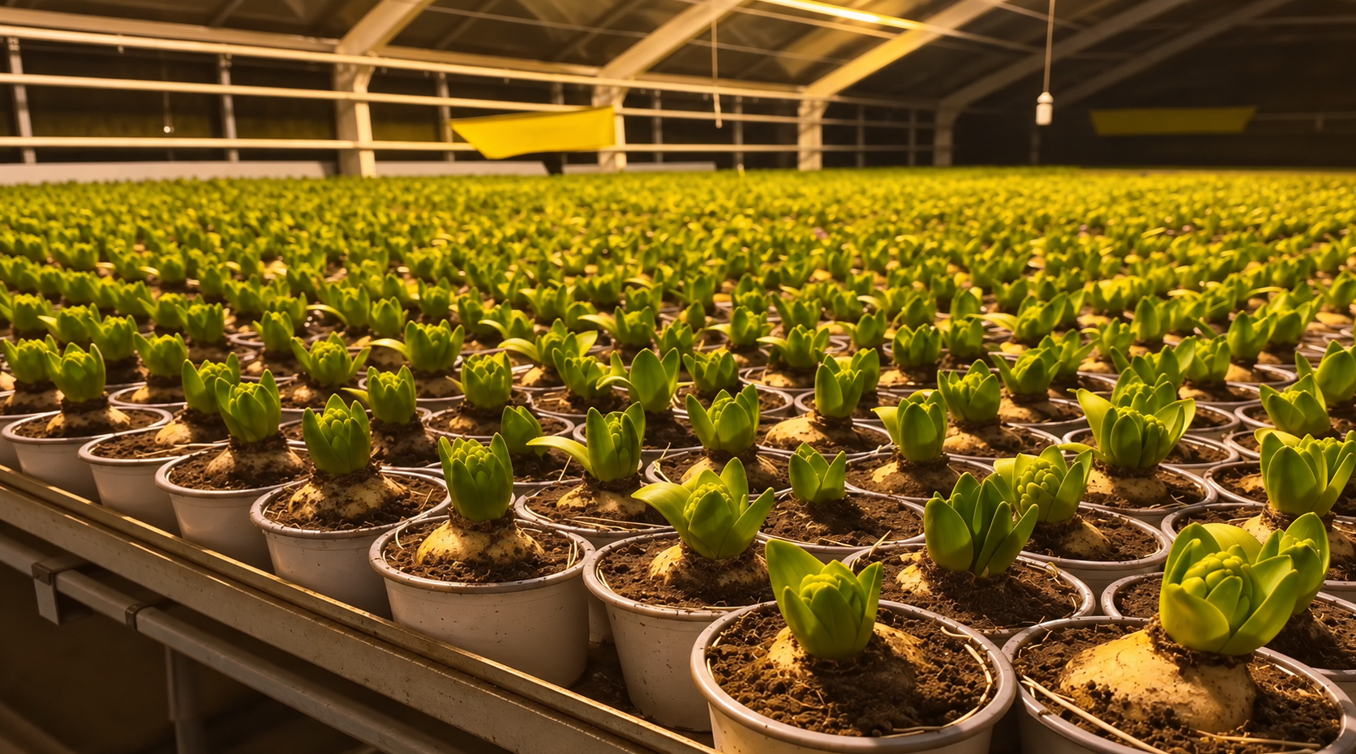
In Espoo, Finland, tulips are opening weeks before Christmas inside a greenhouse that has been in the same family for about 140 years. Generations of growers have adapted to changing seasons, technologies, and ways of doing business. The latest innovation is perhaps the most unexpected: sixteen Avalon Q units, lined up along one wall, are producing computing power while the recovered heat warms the water flowing beneath the flower beds. This is agriculture, powered by Avalon.
"Farming is fun," says Niclas Hallgren, who studied agriculture for three years before taking over the family business. "And when it comes to tulips, temperature is everything."
It's a simple observation, but it goes to the heart of the operation. Growing tulips requires careful temperature control at every stage. For this crop, his company Traskandan Kauppapuutarha maintains temperatures of around 9°C during storage and 17°C during the growing phase. Getting those conditions right is essential to producing healthy flowers and bringing them into bloom on schedule.
What heat costs a flower farm
Heating is one of the farm’s largest controllable operating costs, at a time when financial support for growers is becoming increasingly limited. With subsidies shrinking, keeping the greenhouse warm through the winter requires roughly 140 tonnes of wood pellets, supplemented by heating oil.The scale is easier to feel in flowers than in euros. At the price the farm receives for the tulips, it has to sell the equivalent of about 60,000 tulips a year just to cover its heating costs.
The pressure is particularly evident in the wholesale market. A bucket of 20 tulips leaves the farm for about half the price a flower shop charges a customer for that same bucket. The grower bears the cost of heating and production, while much of the retail margin sits further down the supply chain.
Plumbed into the loop that was already there
Rather than being installed as a separate heat source, the Avalon Q units were integrated into the existing water-heating system, alongside the wood-fired boiler.
Both feed a 100-cubic-meter tank, which takes about three days to heat from cold and then operates at temperatures ranging from 50°C to 90°C, depending on the crop’s needs. Water circulates from the tank through pipes beneath the flower beds, while circulating fans distribute the warmth throughout the greenhouse.
The Avalon Q units start giving off heat the moment they start computing. No warm-up, no combustion, no fuel delivery.
The control logic is an important part of the system. The units operate only when Nord Pool spot electricity prices fall below €0.07 per kilowatt-hour. When power is more expensive, they switch off, and the boiler carries the load. When power is cheap, the farm uses it to produce heat it needs anyway, with the Avalon units providing an additional source of revenue.
"I can check whether the machines are online anytime," Niclas Hallgren says. "It's incredibly convenient."
What it gave back
The impact on fuel consumption became apparent within the first two months. November and December alone accounted for a reduction equivalent to about 11% of the wood pellets the farm typically uses over an entire winter.The installation is one energy system: Avalon Q units with solar and battery storage. Based on the grower’s estimates, the combined system has a simple payback period of roughly two years. The fuel savings achieved during those first two months represent approximately one third of the annual savings needed to reach that payback target.

The compute provides another return. Over ten months, the sixteen units generated 0.14 BTC while simultaneously supplying heat to the greenhouse.
And the operation doesn’t stop in the summer. During the offseason, the units are moved to outdoor cabins, where they continue mining. In winter, the glasshouse also takes in neighbors' plants for the cold season, maintaining around 4°C through the coldest months. A unit or two sits in the office, where the warmth is the whole point.
The part that scales
What this farm has demonstrated on a relatively small site points to a much bigger opportunity as compute infrastructure expands. Electricity demand is growing, and computing facilities are generating increasing amounts of heat that typically must be removed at an additional cost.A greenhouse inverts that. Here, the heat is not a byproduct to be discarded. It is something the farm already needs and pays to produce. The compute infrastructure provides that heat while performing another valuable function - securing the network and generating digital assets.
The idea extends beyond a 140-year-old flower farm. District networks, pools, laundries, dryers, fish farms and dozens of industrial processes buy low-grade heat today. Integrating compute with existing demand for heat can put the same electricity to two productive uses.
The broader lesson is that compute infrastructure doesn’t always have to compete with surrounding energy needs. When it is located where its heat can be put to work, it can become part of the local energy system rather than simply another source of electricity demand.
Energy will remain constrained in most places. At Canaan, we believe that the growing advantage will belong to operators who can extract more value from every megawatt of power, producing computing capacity while delivering useful heat to the communities and businesses around them.