


publish date 2026-11-17
Welcome back! This is Canaan's weekly newsletter on energy and compute infrastructure.
COP31 opened in Antalya on Monday, and for the first time, a UN climate summit has a pledge written for data centers. The Antalya AI Pledge, drafted by the Türkiye presidency with the ITU, will be formally launched on November 16. Its four pillars cover clean power for AI infrastructure, responsible design and procurement, reporting of environmental impacts, and support for developing countries.
It does not include a target. Signing is voluntary; it sets no targets and imposes no new obligations. The pledge is a bet that measurement comes before mandates.
https://x.com/verge/status/2119901410590617608
The thing it measures keeps growing. The IEA puts data center electricity use at 415 TWh in 2024 and projects around 945 TWh by 2030, slightly more than Japan consumes today. And the two countries driving most of that growth sit at odd angles to the pledge: the US has no official delegation at COP31, and in China, coal supplies roughly 70% of data center power, per the IEA.
Critics see that as the weakness. The World Resources Institute welcomed the pledge but argued it needs accountability: clean power, full disclosure of energy and water use, and companies paying for their own grid connections.
Europe offers a preview of where disclosure leads. EU data centers above 500 kW already report energy use, water, percentage of renewable energy used, and waste heat reuse. In September, the Commission adopted an A-to-G rating scheme built on that data, with labels that show whether a facility is ready for waste heat reuse. The early numbers are modest: according to reporting on the Commission's own memorandum, only 67 data centers reported any reuse, about 1.8% of the heat generated.
Germany went further. Under its Energy Efficiency Act, new data centers commissioned from July 2026 must reuse 10% of their energy, rising to 15% in 2027 and 20% in 2028. Operators have pushed back, and a June draft amendment would exempt sites where a heat network connection is not viable.
Nearly every watt a data center consumes leaves as heat. Once that heat is counted, it starts to look less like waste and more like a product, provided the buyer is close enough. Canaan's Nordic district heating project, now fully operational, feeds the heat from its machines into the supply for roughly 2,800 households.
https://x.com/BitcoinNewsCom/status/2111877107634893221
A voluntary pledge will not settle how much AI should consume. It may change what gets reported. If Antalya follows Brussels, the next question asked of a data center may be not only where its power comes from, but where its heat goes.
In the News
-
IREN AI Cloud Revenue Triples to $200M as $4B ARR Target Slips to 2027
-
Constellation Secures 1,000 MW of New Emissions-Free Power Generation
-
WhiteFiber Secures $300M Financing for North Carolina Data Center
-
Ionic Digital Revenue Rises 32% as AI Leasing Income Outpaces Cash Rent
-
Binance Is Shutting Down Its Bitcoin Mining Pool After Six Years
-
Solo Bitcoin Miners Strike Digital Gold as 2026 Jackpot Wins Reach 36 Blocks
Network at a Glance
-
BTC price (USD): $74,479
-
Network hashrate: $955 EH/s
-
Difficulty: ~148.36 T
-
Hashprice: $31.35 USD per PH/s per day

Project Spotlight
The A1566I is the immersion member of the A15 family, and with it, the newsletter has now covered the series in air (A1566), hydro (A1566HA), and fluid.
Canaan introduced it in mid-2024 as its third-generation immersion miner. Current listings rate it at 261 TH/s at 4,500 W, about 17.2 J/TH, in a compact 292 x 171 x 301 mm chassis built to sit submerged in dielectric fluid rather than in front of fans.
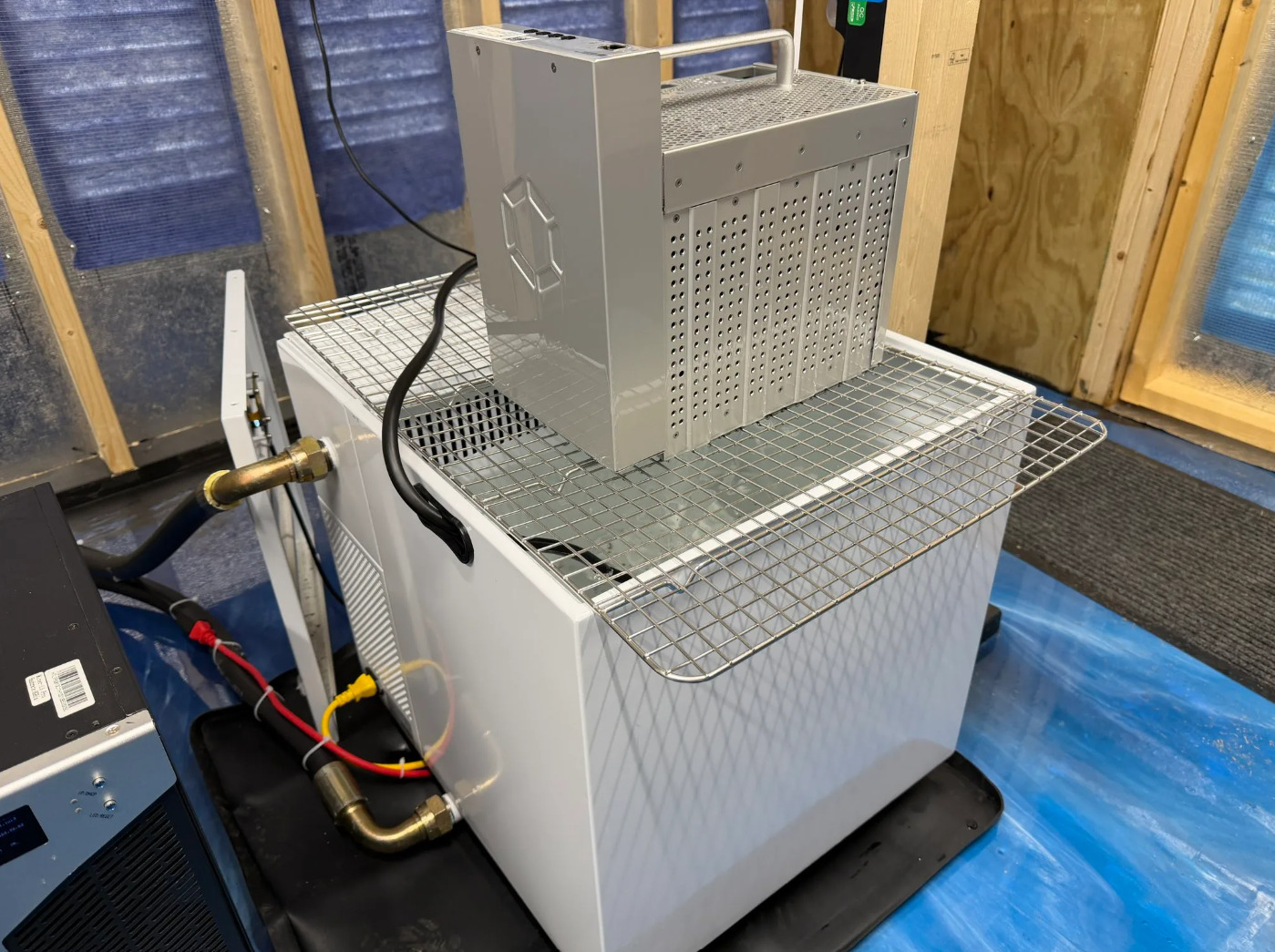
Immersion solves two problems at once. With no fans, the machine runs at around 50 dB, and the fluid carries heat away far more evenly than air, which lets chips hold higher sustained clocks. The second benefit ties back to this week's theme: heat captured in a liquid loop is much easier to move somewhere useful than heat blown into a room. Each A1566I gives off roughly
15,000 BTU per hour, about the same as a 4,500 W space heater.
For operators weighing heat reuse, that is the point of the immersion line. The hashrate is the product, and the heat is something that can be sold.
Setup of the Week
A keyboard, a four-legged friend, and a couple of Nano 3S to stay warm during the winter (@Mike18143)
https://x.com/canaaninamerica/status/2118109320500138374
Events and Media
-
Gwyn Lauber, vice president of corporate affairs, delivered a keynote at Bitcoin Amsterdam on November 6.
-
BTCSessions reviewed the Avalon Q.
-
Canaan reported third-quarter 2026 results, including a conditional ERCOT Batch Zero classification for its 1 GW Duval County, TX, project, a second 1 GW Texas project in early-stage development, and a new US$20 million share repurchase program under a US$100 million board authorization.
Follow and Contact Us
-
YouTube: Canaanmining
-
LinkedIn: Canaan Inc.
-
Website: canaan.io
-
Support: Customer Care
Disclaimer: This newsletter shares industry commentary and third-party news for informational purposes only. The views and opinions expressed by third-party sources are those of their respective authors and do not necessarily reflect the views of Canaan Inc. For official news, please refer to Canaan’s press releases and SEC filings at https://investor.canaan-creative.com/.